Special Edition: Maternal Health BINGO
July 7, 2026
Happy summer, dear readers! Sorry I've been away so long. You see, I was busy doing a thing that kills a woman every 2 minutes (source): giving birth.
Congratulations!
Thanks.
Boy or girl?
Girl! Her name is Elizabeth Patience and she will be a feminist media critic soon enough. After all, even children's media gets plenty of mileage out of the "Death by Childbirth" trope (see: Star Wars), so she'll learn early how dangerous the world is for women.
By the way, did you die?
No, but it was a nearer thing than I would've liked.
In honor of the experience, I asked longtime DFGRR member Dr. Sarah Otterson to help me make this special version of DFGRR BINGO, and would like to play it with you today.
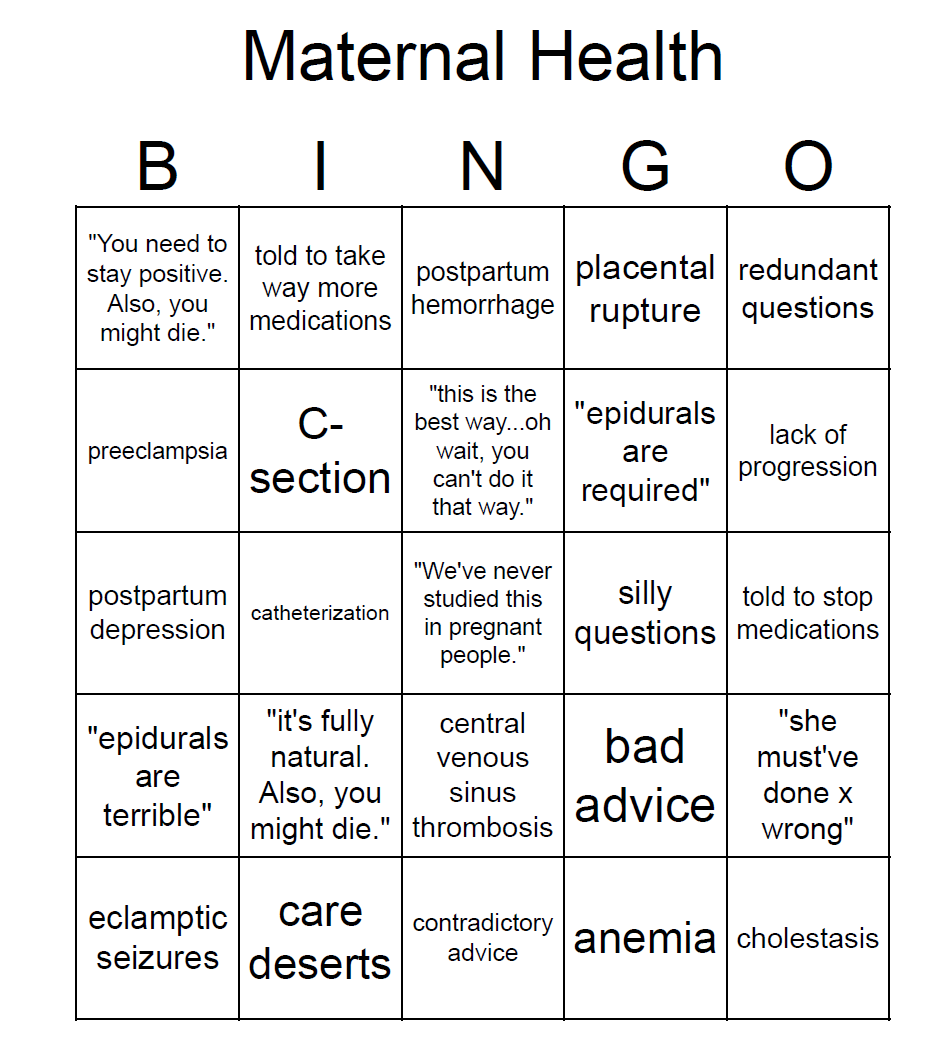
If you'd like to play along, you can print out one of these BINGO cards and cross off squares as we go.
Are you ready for round 1?
I have my BINGO card and my pencil.
Let us begin with my first round of doctor's appointments, shortly after discovering I was pregnant. I will summarize how that went.
Obstetrician: I see you are on [long-term medication for nerve pain]. That's never been proven safe for the fetus. You should probably discontinue it, but check with your prescriber first.
Prescriber: Discontinuing it would put you through withdrawal symptoms, which are known to be unsafe for fetuses. Plus then you'd be stuck with unmedicated pain, and stress is very bad for fetal development, too.
Me: So...I should continue it?
Prescriber: Well, we can't tell you to continue, because it's never been proven to be safe for the fetus.
Me: So...what should I do?
*crickets*
Prescriber: ....you could try looking it up on mothertobaby.org.
Mothertobaby.org (a really useful website): Although it's never been proven safe, [medication] has also never been connected to adverse outcomes in pregnancy or breastfeeding.
Me: I'd like to continue this medication for my own safety and well-being.
Obstetrician: That's fine! We'll just monitor the baby very closely.
Me: Were we not planning to do that anyway?!
Phew. I was weeks into a pregnancy and could already cross off "told to stop medications", "We've never studied this in pregnant people," and "contradictory advice."
I am politely asking medical science to study the female body.
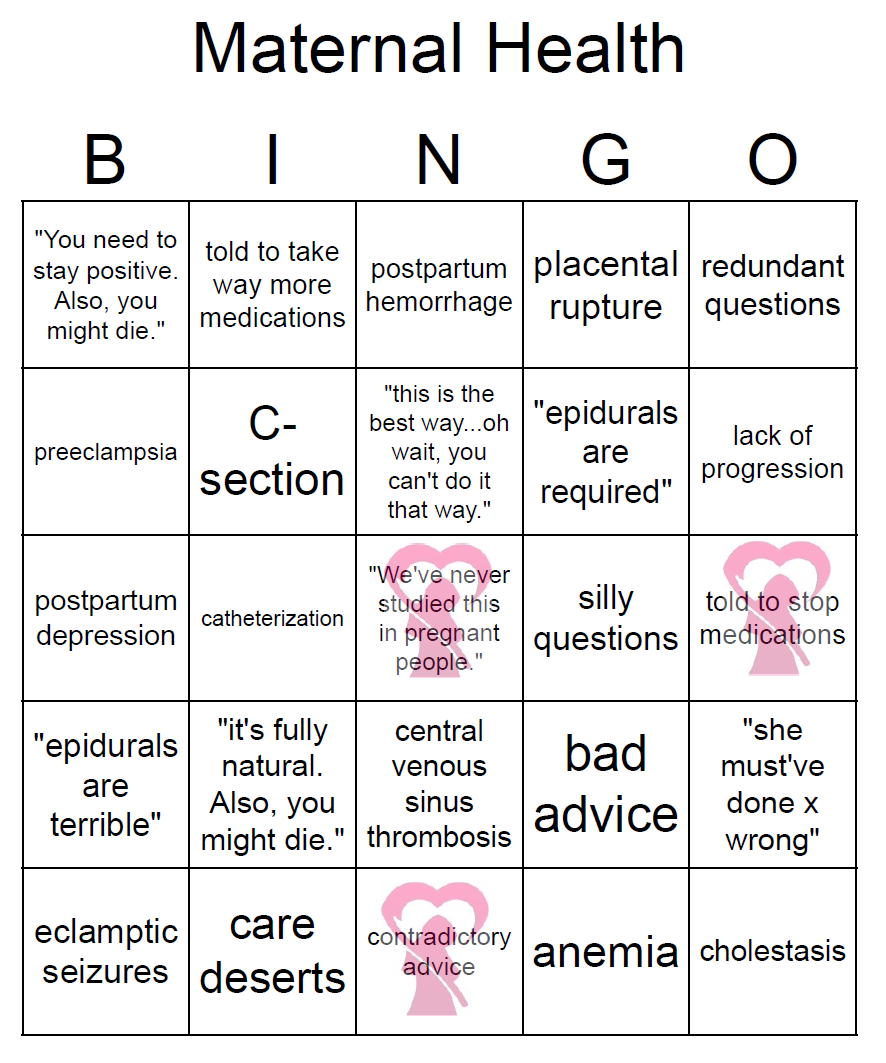
All 3 of those would become recurring themes, as I navigated things like catching a cold while pregnant (no one has ever studied whether cough drops are safe) or asking if I could have a sip of champagne while pregnant (European doctors say yes, American doctors say hell no, and neither group has ever consulted the opposite group's data).
I am once again asking medical science to study the female body.
Sounds confusing, but I'm ready for round 2.
Okie dokie. As I wrapped up my first trimester, I started telling people I was pregnant. Reactions were consistently positive, even effusive, which was nice. Less nice was how people started to police my thoughts. If I mentioned something like high maternal mortality / morbidity rates, I got "but that won't happen to you, so don't worry about it." My doctor made me cry by dismissing a serious medical question with "It's a fully natural process. You need to stay positive." When I later asked this same doctor whether C-sections came with a hemorrhage risk, she said - and I quote - "You could die from a vaginal birth, too." It went on and on like this. Any concern I had, no matter how realistic or benign, got a dismissive reaction.
Or worse, a victim-blaming reaction. When I brought up a casual acquaintance who died from complications of childbirth (and whose memorial was held in the same venue as my baby shower), people were quick to point out that her death was probably her own fault because she smoked. At one point, I asked my father, "Do you want people to be at my funeral saying that I probably died because I didn't discontinue my pain medication?!"
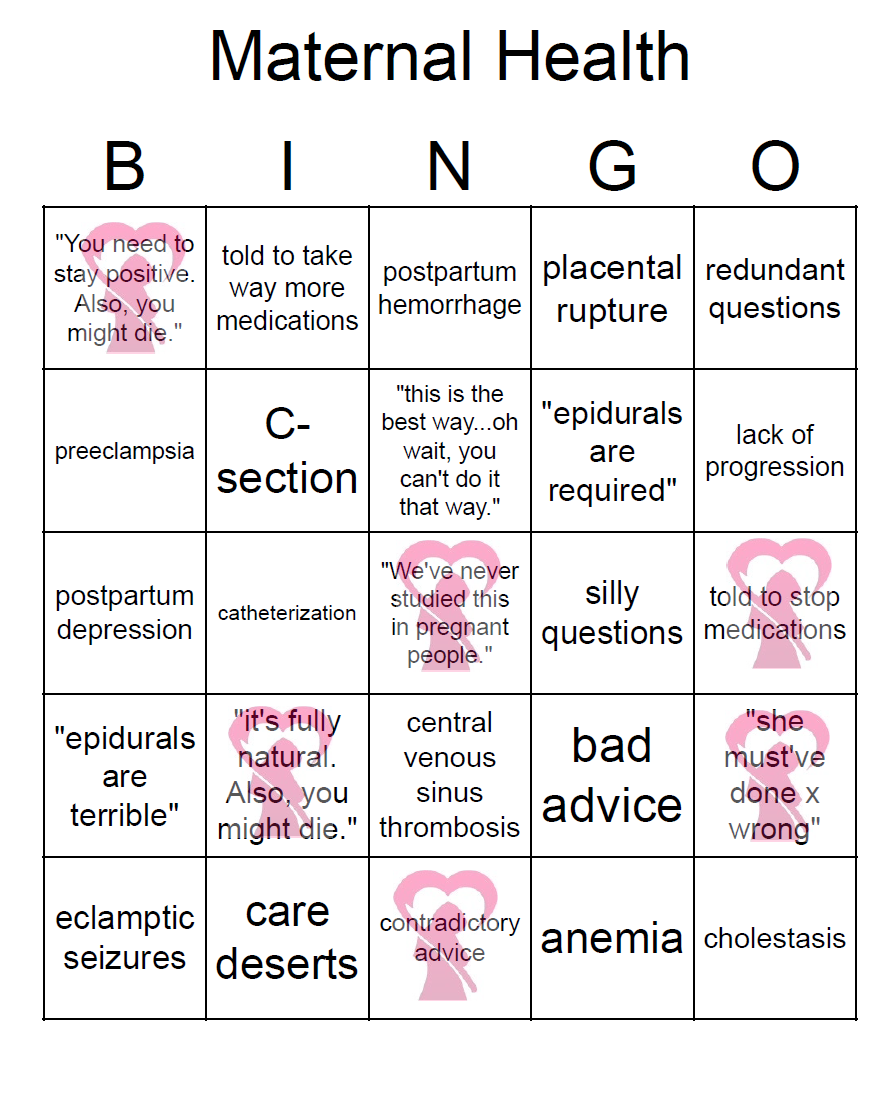
For those of you keeping score at home, this covers the squares "You need to stay positive. Also, you might die;" "It's fully natural. Also, you might die;" and "she must've done X wrong."
Aren't those comments true, though?
IT DOESN'T MATTER. You're supposed to ask whether something is true, helpful, and kind before you say it out loud.
Ah. Fair enough. What's in round 3?
Buckle up, because the third trimester is where things really went off the rails. For reference, keep in mind that pregnancy lasts about 40 weeks, but 36 weeks is the earliest a baby is considered "full-term" rather than a preemie.
At week 32, I was suddenly itchy all over. At the hospital, I was diagnosed with cholestasis in pregnancy - a rare condition in which pregnancy hormones make a person's liver stop working properly. This leads to bile acid building up in the blood, which in turn can cause preeclampsia and stillbirths. The cure for cholestasis is to deliver the baby, but we were 1-2 months too early to do that safely. So, I was started on medication to manage symptoms and told to try to wait at least 4 more weeks.
1 week later, I was diagnosed with preeclampsia, although luckily it was the "without severe features" kind. At the same appointment, my iron tests were rather low, and the baby's estimated weight was rather high. The maternal fetal medicine specialist asked, "Do you have any female relatives? This combination of complications usually runs in families." I replied that I could give you details of the pregnancies of my mother, grandmother, and great-aunt, plus three biological aunts; that my six female first cousins have a total of eight children among them; and that none of these people ever had cholestasis and preeclampsia and anemia. "In that case, you're just unlucky," was her response.
Seriously? Is "dem's da breaks" an actual medical diagnosis?
I am begging medical science to study the female body.
Is there any chance of that?
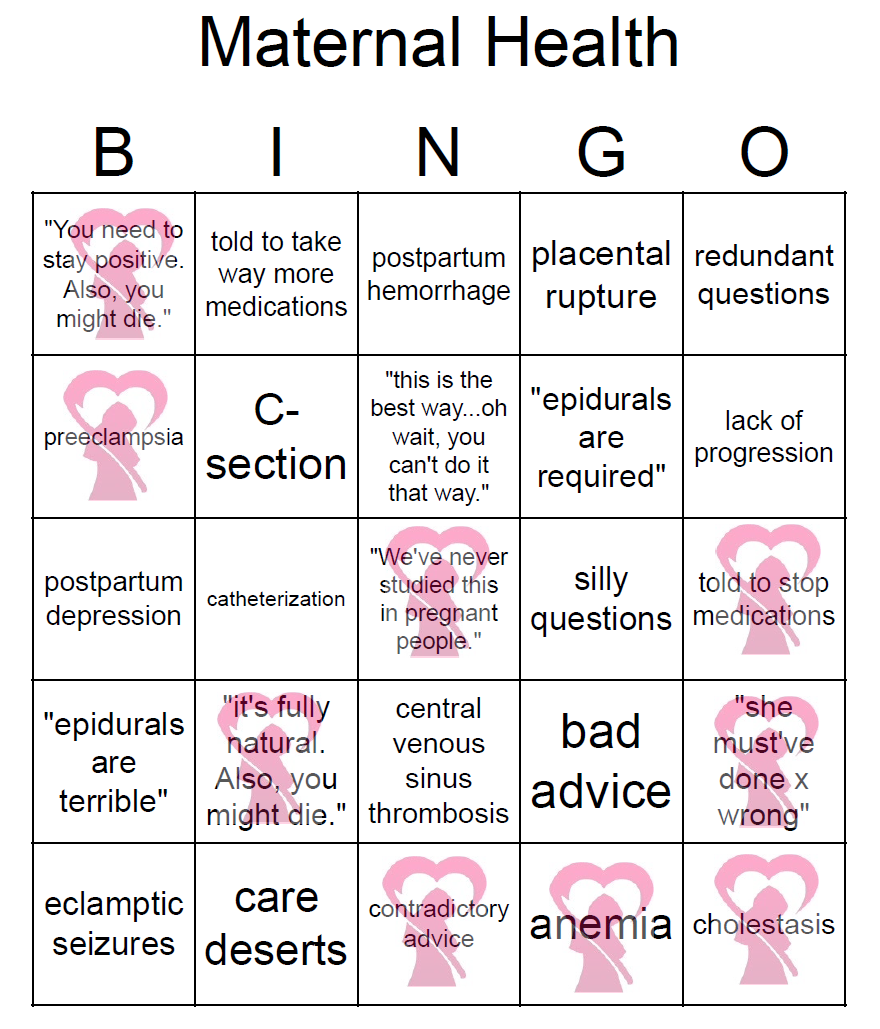
Apparently not. Anyway, that covered 3 more squares for our BINGO card.
I shudder to contemplate round 4.
You should.
The new plan was to induce labor at 36 weeks. I hurried to finish prenatal classes, in which I was told:
- Epidurals, while a fine thing, can be bad for you in some cases, so don't ask for one unless you really need it.
- Once you give birth, the baby will be handed to you immediately for skin-to-skin cuddling which will help you bond / be super healthy for them / get breastfeeding off to a good start.
- In the hospital, you and your partner will share a room with your baby so that you don't have to have her out of your sight.
Did any of that happen?
Of course not. Instead, my preeclampsia got worse 5 days before my planned induction, and I got sent straight to the hospital. There, I spent 8 hours just waiting for an induction to start, then 3 days failing to progress.
The whole time, I had to verbally brief each nurse in charge of my care on the exact same facts about my medical history and allergies over and over. They do this to minimize mistakes, but it led to some strange conversations.
Nurse on Day 1: I see you've had 3 concussions. Are you an athlete?
Me: No.
Nurse on Day 2: I see you've had 3 concussions. Do you need to talk to a social worker?
Me: No.
Nurse on Day 3: Can I ask you a personal question? How did you get 3 concussions in 7 years?
Me: Dem's da breaks.
Oh, and those ask-if-you-need-one epidurals? Turns out they're offered to most American women before the pain even gets going, and if you say you don't want one, it becomes A Thing. See, a few years ago I had a bad reaction to bupivacaine, and that's the main medication this hospital uses for epidurals. Therefore, I opted to request IV pain relief instead of epidural. You would've thought I'd sprouted a second head. The various nurses and my doctor kept paging anesthesiologists to come "consult" with me, although I said the same thing in every consultation. This happened five separate times.
Pause here to stamp "lack of progression," "epidurals are required," and "redundant questions."
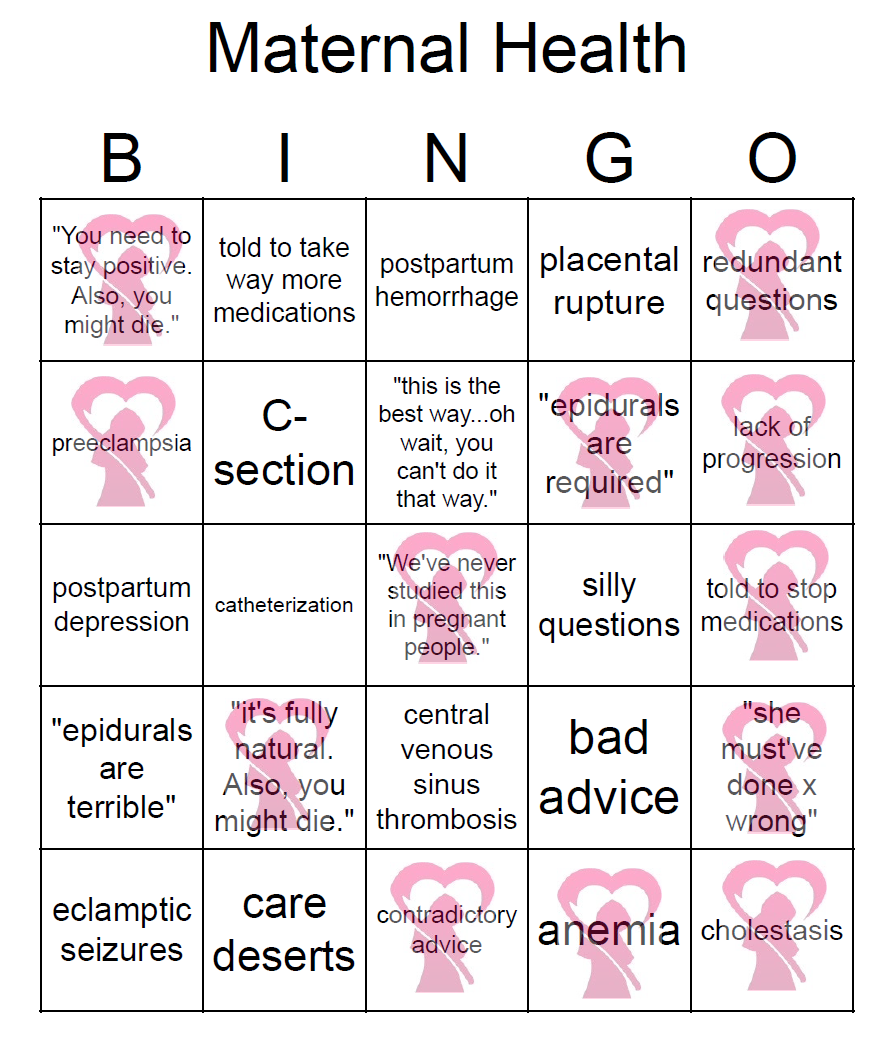
BINGO!
Bingo, indeed.
By this point my preeclampsia had developed severe features, which meant I was on full bedrest and urgently needed to not be pregnant anymore. Consequently, we can also stamp "catheterization", "C-section," and "this is the best way...oh wait, you can't do it that way."
Wait, how did we get that last one?
Ah, you see, if you have a C-section you don't get to decline an epidural, and don't get to hold your baby skin-to-skin right away. In my case, I got to lose an abnormal amount of blood and go into shock, which means I barely remember the first 12 hours of my kid's life. I was on complete bed rest, so I couldn't have done anything for her anyway. Fortunately, she had her father to change, swaddle, and hold her; she was only handed to me to attempt breastfeeding.
Then, when she was 24 hours old, I was let off bed rest to go to the bathroom. I got so dizzy in the process that I had to pull the emergency bell. Did you ever wonder what happens if you pull that cord in a hospital bathroom?
No, what?
4 nurses come running, that's what. They scooped me back into bed and then paged a doctor, who sent back instructions:
- Give Claire 2 units of donor blood.
- Take Elizabeth to the nursery and feed her donor milk.
A modern hospital in 2026 actually took the baby away to the nursery?!
Yuuuupp. In all fairness, it was for our own safety; on the other hand, it made me a nervous wreck. My day-old child was going to be with strangers?! My husband wanted to stay by my side, since I was very weak, so we called my mother and she sat outside the nursery all night to watch Elizabeth through the window. And the hospital billed my insurance - I am not making this up - $19,500 for the service.
Also, I got a full quart of someone else's blood pumped into me.
What was that like?
Lifesaving! As a longtime blood donor, I have put approximately 8 gallons into the supply chain, so it all balances out, really.
In further silver linings, it means I win BINGO two ways.
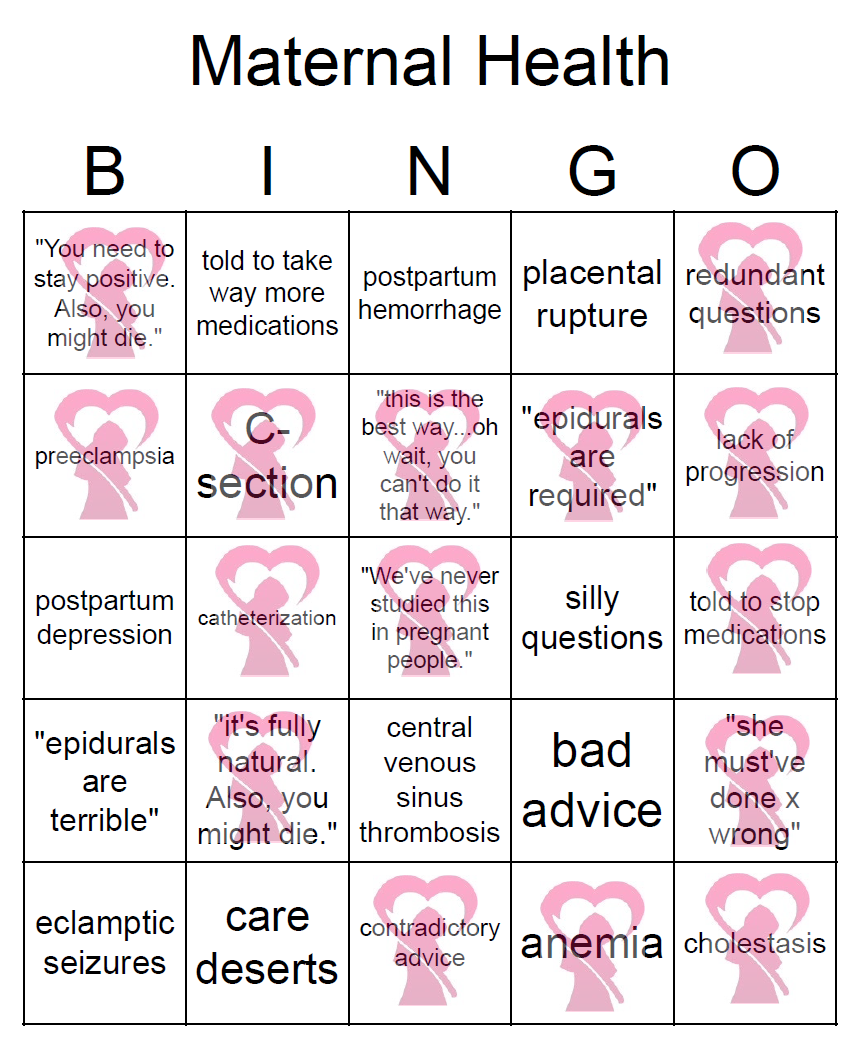
Well. What's the prize?
A daughter! She's great.
Right, congratulations. Anything else?
There's also the postpartum preeclampsia, which got me a medical alert bracelet and a state-funded sphygmomanometer to keep at home. It might go away eventually, or maybe not. This part is not great, though it could be worse.
Have we learned anything from this process?
First of all, all women 100% need to have access to high-quality obstetric care. This may sound pretty basic, but did you know that 35% of all counties in the US are maternity care deserts? (Source: March of Dimes.) 2.3 million American women of reproductive age have nowhere to get the kind of care that saved my life and the life of my daughter. Is it any wonder that the US has the highest maternal mortality rate of any country of similar wealth? (Source: The Commonwealth Fund). We might want to demand better.
Second, the US desperately needs single-payer healthcare. Because I spent a week there, the hospital billed my insurance $100,000 for my care and $22,000 for Elizabeth's. And that's just the hospital. That's not counting labs, specialists, prenatal or postnatal care. Even with insurance, I was expected to pay 10% out-of-pocket. The US has the most expensive healthcare in the world, and it's a ripoff. It can be hard to quantify exactly how much we're being bilked for, but consider this: the Bureau of Labor Statistics says the median annual employee contribution for a single person's insurance premiums is about $6,500 (source), and then you have to pay copays. Meanwhile in Canada, single people pay about $5,700 in healthcare taxes (source), get to give birth for free, and have a maternal mortality rate 2/3rds lower than ours. I can tell the math ain't mathing. We should demand better.
Third, paid family leave should be a right. Luckily, in my state, it is - but that's only the case in 13 US states. Thirteen. This means that in most states, women who go through similar things are forced to get back to work ASAP. Let me tell you, that wouldn't have worked for me (see: "nearly died and now have chronic complications", above.) It makes my blood boil to think of all the women who are put in that position. If you live in one of those states, it's time to demand better.
Keep your sexy lamps burning.